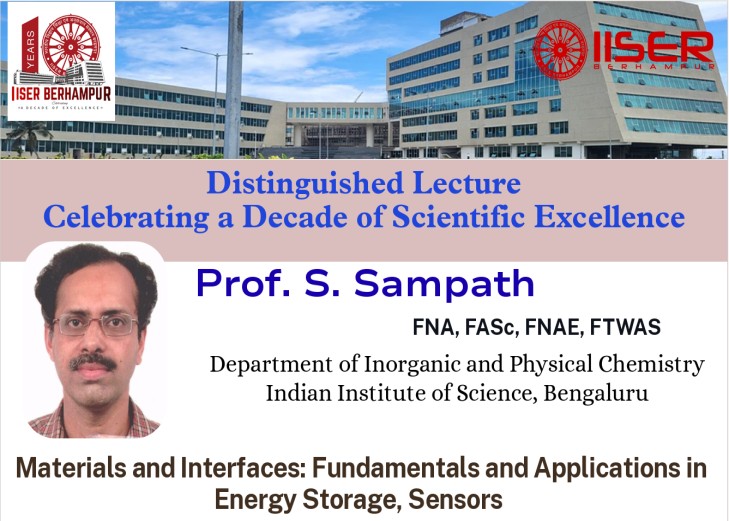
Date: February 18, 2026
Time: 05:30 PM
Venue: Lecture Hall 1003, Block 7, IISER Berhampur
Flyer Link: Click here to view
From a Chemical Curiosity to a Portable Device
About a decade ago, we discovered a facile method to enhance the luminescence from lanthanides through the self-assembly of multiple components in a metallohydrogel. Using this strategy, we have developed a pro-sensitizer (‘masked sensitizer’) based protocol for sensing hydrolases and bio-relevant small molecules. We have also discovered that several natural products and clinically used drugs can sensitize lanthanides. The gel-based platform, therefore, provides opportunities to detect and quantify such species as well.
The advantage of this technique is that the output (green/red photoluminescence of Tb3+ /Eu3+ ) is independent of the analyte being sensed, and in many cases pre-processing of the sample is not required. For several enzymes present in blood serum and natural product extracts, the presence of the analyte can be readily inferred using an inexpensive, hand-held long-wave UV lamp. We have also developed a low-cost, paper-based method, and a portable device (Fig. 1) to simplify the assay. We believe that further developments can lead to useful, real-life applications.
Prof. Uday Maitra - Prof. Uday Maitra is an Indian organic chemist and a professor in the department of organic chemistry at the Indian Institute of Science, Bangalore. He is known for his studies on molecular tools and supramolecular assemblies. He is also greatly interested in Chemistry Education and frequently runs a show “Chemistry is Fun!” for school and college students. He is currently Chair of the IUPAC Committee on Chemistry Education and a member of the Science Board of IUPAC.
After completing his MSc in Chemistry from IIT Kanpur in 1981, Dr. Maitra earned his doctorate from Columbia University in 1986 and postdoctoral from the University of California, Berkeley. His studies are characterized by the new methodologies he employed in developing supramolecular assemblies and molecular tools like receptors, tweezers and gelators.