Date: August 17, 2026
Time: 05:00 PM - 06:00 PM
Venue: Lecture Hall 2003, Block 7, IISER Berhampur
Flyer Link: Click here to view
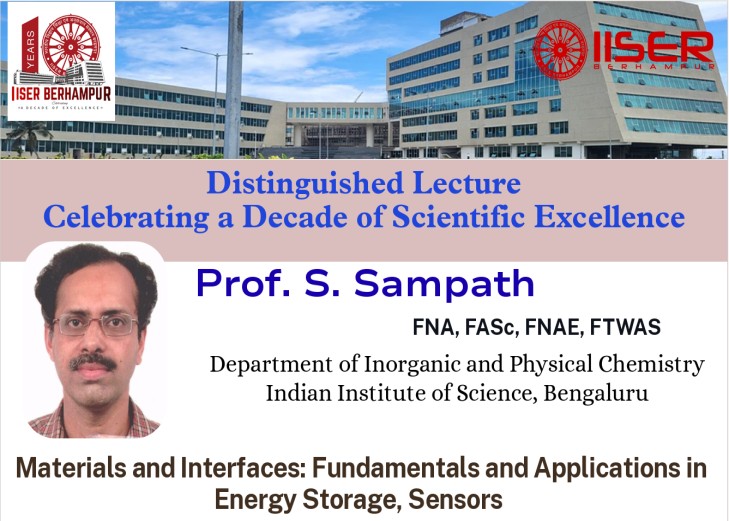
“Materials and Interfaces: Fundamentals and Applications in Energy Storage, Sensors ”
Prof. S. Sampath - Prof. S. Sampath is a distinguished chemist and Professor in the Department of Inorganic and Physical Chemistry at the Indian Institute of Science. His research lies at the interface of materials chemistry, electrochemistry, and nanoscience, with particular emphasis on surfaces and interfaces, novel electrode materials, energy-storage systems, sensors, and electrocatalysis. His group combines spectroscopy, microscopy, and electrochemical techniques to understand interfacial processes and develop materials for applications such as batteries, supercapacitors, fuel cells, and sensors. Prof. Sampath is a recipient of the Shanti Swarup Bhatnagar Prize in Chemical Sciences (2006) and the MRSI Medal (2006), and is an elected Fellow of the Indian Academy of Sciences, Indian National Science Academy, National Academy of Engineers and The World Academy of Sciences. He has also served in several academic and scientific advisory roles and currently heads the Department of Inorganic and Physical Chemistry at IISc.
Research and development in the areas of energy storage and sensors have seen a resurgence in recent years. In this direction, electrochemical energy storage systems have gone beyond lithium ion batteries. The interfacial characteristics determine the thermodynamics as well as the kinetics of redox processes involved. The interface consists of a small thickness of ions and molecules that range from tens of nm to several microns. Nature of electrode materials (morphology / size) and electrolyte along with a potential difference play significant roles in the efficiency of the device. For example, electrocatalysis, capacitance at an interface and kinetics of redox reactions leading to energy storage (batteries / fuel cells / capacitors) can be tuned using these variables. In addition, structure of the solvent near an electrode surface is determined by the nature / composition of the electrode material.
Our group has been interested in understanding various electrochemical interfaces involving solid-solid; solid-liquid and liquid like-liquid interfaces. This includes modified surfaces and new electrode materials involving molecular systems as well as materials. The present lecture will describe certain attributes of the above. Some of the research problems that our group has been involved in, are related to, for example, orientation dependence in electrocatalysis, water structure at a hydrophobic surface and in situ polymerization at water-air interface under surface pressure. Materials based on nitrides /carbides / layered chalcogenides and polymers that are of current interest with respect to energy conversion and storage will be briefly discussed in addition to certain molecular systems.


